Asset Maintenance
Premium Launch −30%CMMS: requests, stage-based work orders, meter-based preventive maintenance and real cost per piece of equipment.
| Technical name | oski_maintenance |
|---|---|
| License | OPL-1 |
| Author | OdooSkills |
$ 89.00
$ 62.30
Launch price — 30% off until December 31, 2026
A ready-to-use Odoo database with demo data, deleted after 1 hour. Odoo 20, 19, 18.
Missing a feature or found a bug?
Request a change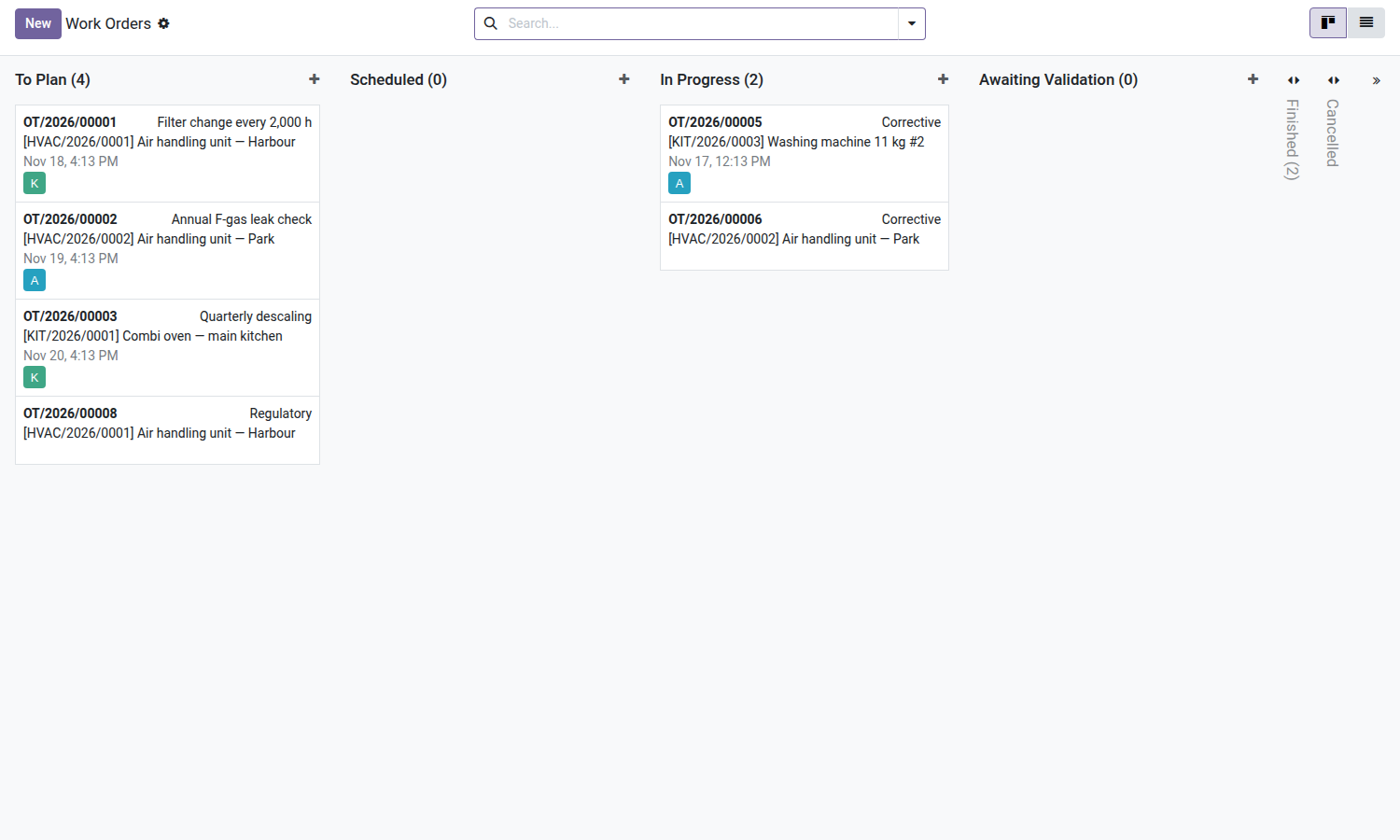
Asset Maintenance
Report, plan, repair — and finally know what each machine cost this year.
The breakdown is reported by phone, jotted in a notebook, repaired — and then it vanishes. Six months later, nobody knows when the server room air conditioner was last serviced, how many times it failed, or what it cost in parts and hours. Preventive maintenance lives in one person's head, and the day that person is on leave, the due date slips by. When management asks "do we keep repairing it or replace it?", the answer is a hunch, not a number. This module runs the workshop: the request becomes a work order, the order carries its checklist, its hours and its parts, and everything lands as real cost on the equipment's life record.
What it adds
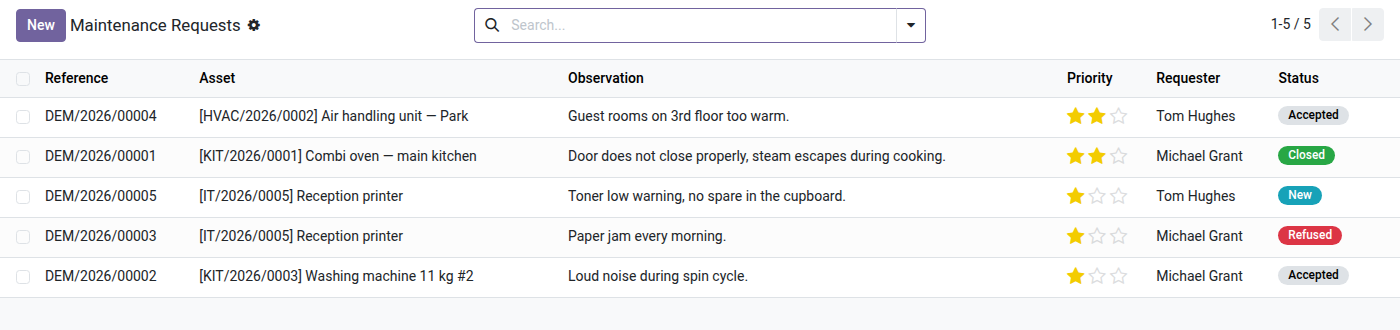
- 📣 Reporting is open to the whole company — any internal user reports a breakdown on a piece of equipment, with a photo if they like. The priority is pre-filled from the asset's criticality: what is critical is born urgent. The manager accepts, or refuses with a reason the requester can read — a refusal is no longer silence.
- 🔧 Work orders with free-form stages — to plan, planned, in progress, done, cancelled by default, and you configure your own per intervention type. Cards slide from one kanban stage to the next. A start stage can take the asset out of service: it switches to "under maintenance", and the change is dated and signed in its log.
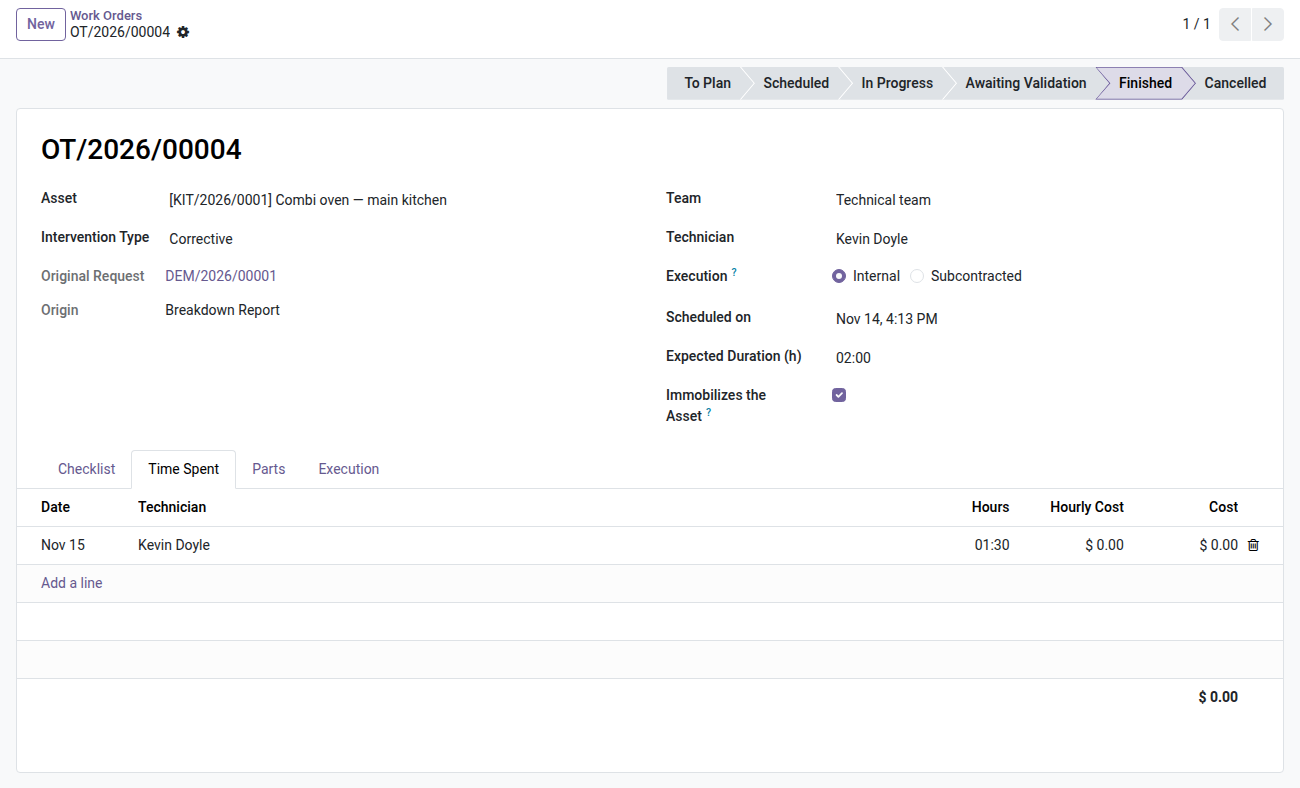
- ⏱️ Real cost, not an estimate — each time entry takes the employee's hourly cost if there is one, otherwise the team's, and freezes it: a pay raise does not rewrite history. Labor, parts and outside services add up on the order, then feed the asset's cumulative maintenance cost.
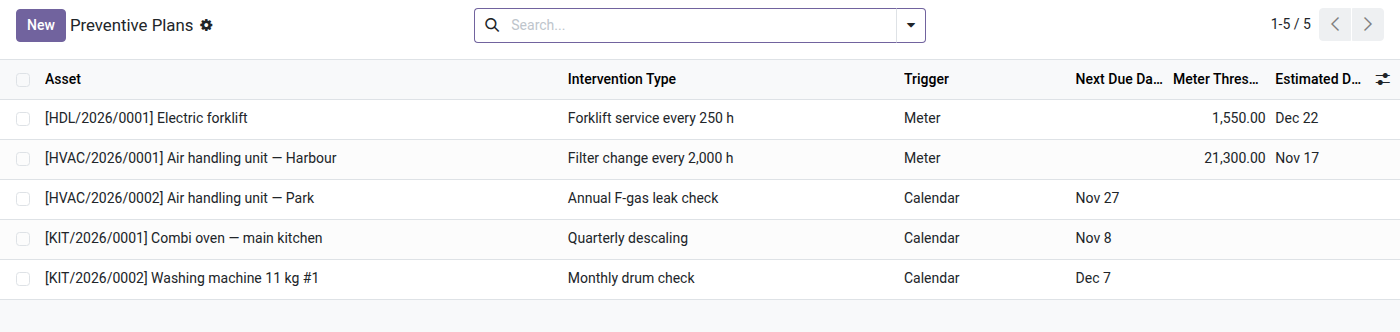
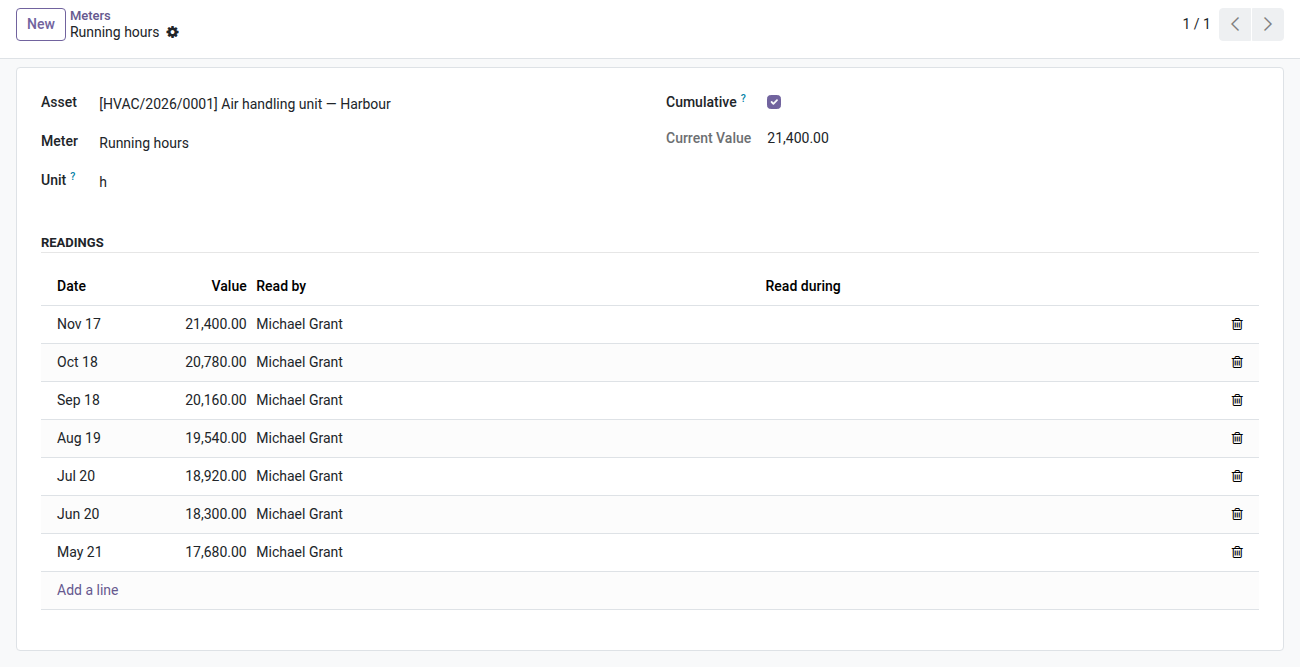
- 📅 Preventive maintenance that does not rely on the calendar alone — every 3 months, yes, but also every 500 hours, every 30,000 pages, every 10,000 km. Meter readings feed an average usage rate that forecasts the likely date of the next due point: you see the service coming before the threshold is reached.
- 🧭 Intervention checklists per type — the operations of a quarterly preventive job are defined once and copied onto every order. The technician ticks them off, and each ticked box records who ticked it and when.
- 🗺️ One plan applied to a whole fleet at once — the same preventive plan is set on every asset of an equipment model: twenty identical air conditioners are not configured twenty times.
- 🖨️ Two documents that actually get used — the work order to take on site (checkboxes for a pen) and the maintenance history of a piece of equipment, cumulative cost included. The life record from the Asset Management core gains a Maintenance block.
- 🔐 Just two groups — technician and manager. The technician sees the workshop, the manager configures stages, types and teams. Nobody else needs an access right to report a breakdown.
Screenshots
1. Work orders by stage
To plan, scheduled, in progress, done: curative and preventive orders together.
2. Time spent and real cost
Each intervention records who worked, how long, and what it cost.
3. Breakdown requests
Reported by staff, accepted into an order or refused with a reason.
4. Preventive plans by date or meter
Every N months or every N hours: orders are generated when due.
5. Meters and readings
Running hours read month after month trigger the meter-based plans.
Why adopt it
- "Do we keep repairing or replace?" becomes a question with a numeric answer: the cumulative cost sits on the equipment record.
- Preventive maintenance no longer relies on one person's memory — nor on a spreadsheet that never sends a reminder.
- The meter-based forecast gives the due date before the threshold: maintenance is planned, not caught up on.
- A refusal with a reason the requester can read eliminates follow-up calls and duplicates.
- Taking equipment out of service is traced in its change log: downtime becomes a dated fact, not a memory.
- No dependency on Inventory, Purchase or Timesheets: the engine runs on the Asset Management core alone, and grows richer as you add the add-ons.
The Assets & Maintenance suite
This module is the CMMS engine. It requires the fleet core, and two add-ons extend it:
- 🏢 Asset Management (
oski_asset) — $49: required. The fleet register, cumulative assignment, traced transfers, documents with expiry dates. - 📱 QR & Portal Reporting (
oski_maintenance_portal) — $29: the label stuck on the machine, the breakdown reported from a phone without an account, tracking for the requester. - 📦 Maintenance Spare Parts (
oski_maintenance_stock) — $39: the part leaves the warehouse when consumed, and its cost rolls up to the asset.
The Assets & Maintenance suite — seven paid modules and two open-source bridges — is $199 instead of $343. Details on apps.odooskills.com.
📦 Need it all? The Asset & Maintenance suite installs all ten modules at once for $299 instead of $460.
License OPL-1 — compatible with Odoo 19.0 Community and Enterprise. Requires oski_asset (Asset Management) and mail. If hr_hourly_cost is installed, the employee's real hourly cost is used automatically; otherwise the team's applies — the module does not force any extra installation on you. Interface in French. Support: apps@odooskills.com.
Discussion
Sign in to join the discussion.