
Balance by Group
Premium Launch −30%One credit limit for the whole group: a subsidiary is refused because its sibling let its receivables run.
| Technical name | oski_partner_balance_group |
|---|---|
| License | OPL-1 |
| Author | OdooSkills |
$ 39.00
$ 27.30
Launch price — 30% off until December 31, 2026
A ready-to-use Odoo database with demo data, deleted after 1 hour. Odoo 20, 19, 18.
Missing a feature or found a bug?
Request a change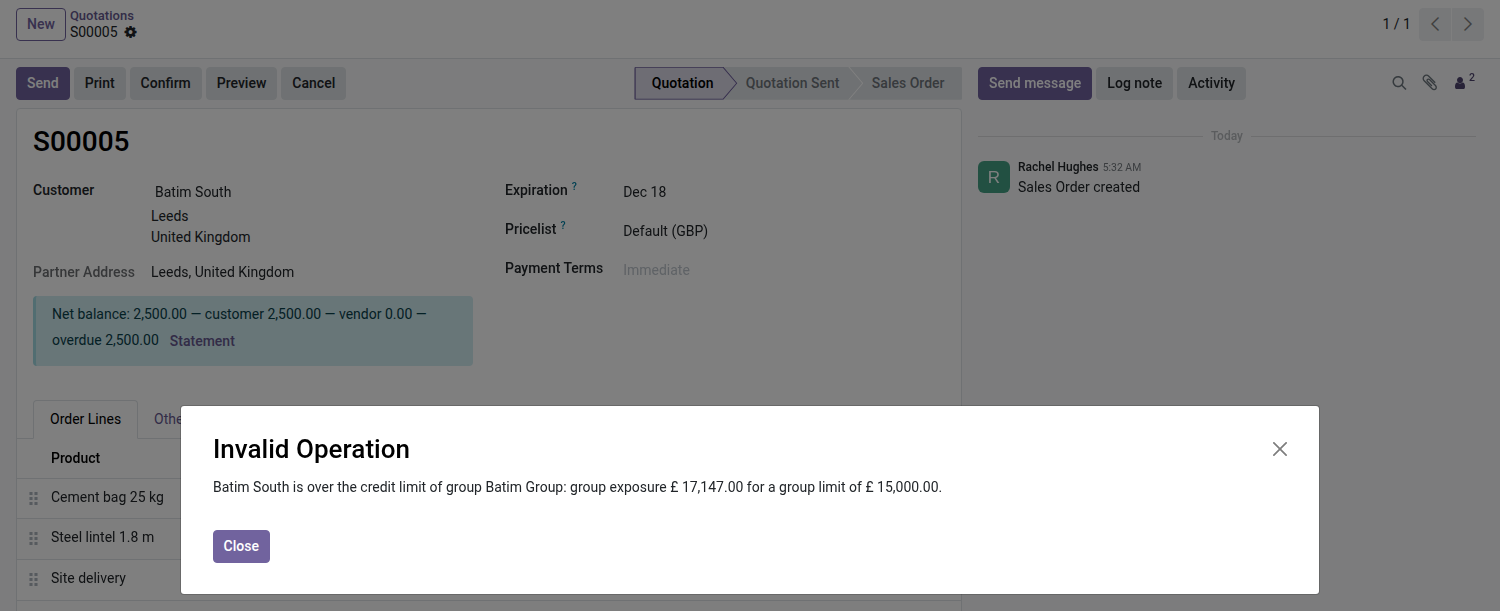
Balance by Group
One negotiated limit for the whole group, applied at every subsidiary: the order is refused because a sibling company let its receivables run.
Requires the paid Credit Limit Control module ($59). This module will not install on its own — it extends Credit Limit Control's engine to a group of companies.
Odoo only knows one partner grouping: a contact rolls up to its company. That's enough to stop a delivery address from carrying its own exposure. But nothing links a parent company to its subsidiaries. And that is the common situation in trading and distribution: the group negotiates one limit, orders arrive through three entities, and the real risk shows up nowhere. Three independent partners, three independent limits, and an overrun nobody sees coming.
What it adds
- ☑️ One checkbox, on the parent, and nothing else. No existing hierarchy gets consolidated without being asked: ticking the box is an explicit act, never a deduction from the contact tree.
- 🧮 The group's exposure weighs on every subsidiary — a quotation entered at one entity is stopped when another has used up the shared limit.
- 🪯 Two limits, two messages. A subsidiary's own limit stays active as a sub-cap, and the message says which one tripped: "this subsidiary exceeds its own exposure" and "the group exceeds the group limit" don't call for the same phone call. Consolidating never loosens a control already in place.
- 🌳 Predictable nested groups — a checked sub-holding wins over the holding above it.
- 🏢 Company by company — the group's exposure is read in the document's own books, never in the session's. Limit, exposure and currency all describe the same company.
- 📄 Consolidated statement — a single running balance for the whole group, in global chronological order, and every line names the subsidiary it came from. An anonymous group statement is useless for whoever is following up.
- 📊 Consolidated aged balance, at no extra cost — if Aged Balance is installed, an open-source bridge adds it the same checkbox and sums buckets by group and by section.
In screenshots
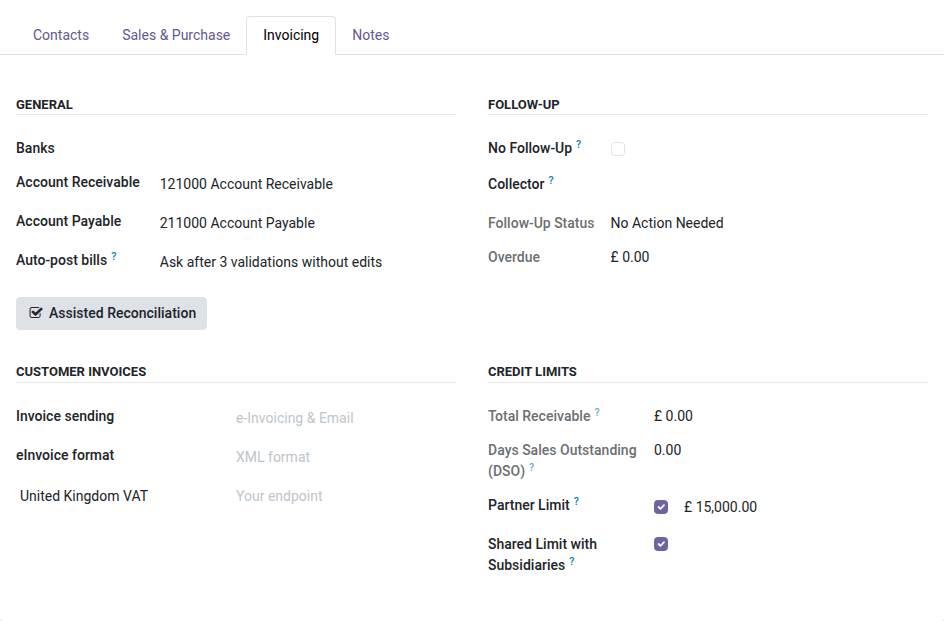
1. One checkbox, on the parent
"Shared Limit with Subsidiaries", right under the credit limit it pools. Until it is checked, nothing changes for anyone.
2. A subsidiary stopped for its sister's debt
Batim South owes only 2,500 and has no limit of its own. It is the group that is over: 17,147 of exposure for a 15,000 group limit, and the message says so.
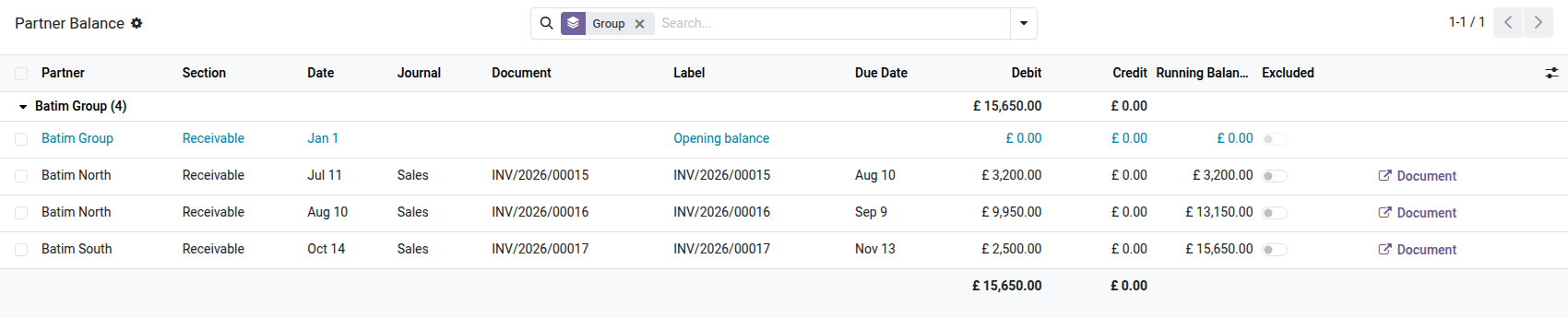
3. The consolidated statement, line by line
Asked from a single subsidiary, it pulls in the whole group in one chronological order, running balance included.
Why install it
- A failing group fails as a whole: by the time one subsidiary stops paying, the other orders have already shipped. The shared limit is the only one that describes the real risk.
- Opt-in is explicit: installing the module changes no partner's verdict until someone checks a box. No production database is altered silently.
- Subsidiaries keep their own sub-limit: consolidation adds a control, it never removes one.
- Nothing to re-key: the group's limit is the parent record's native credit limit field.
Part of the Partner Balance suite
Requires the open-source Partner Balance core and the paid Credit Limit Control module ($59), whose control it extends. With Aged Balance, the consolidation bridge installs itself automatically. Part of the Partner Balance suite — nine paid modules and two open-source add-ons, built on the open-source Partner Balance core. See it on apps.odooskills.com.
License OPL-1. Compatible with Odoo 19, 18, 17. Support: apps@odooskills.com.
Discussion
Sign in to join the discussion.